This is the long-delayed (begun in 2022) Part II of my 2-part blog about my WWI filmic poem/short documentary, now available to rent at, "Pvt. Ravel's Bolero". I just came across this blog in my drafts folder. Rather than wait for my film companion book (far better and detailed than either of this blogs that the book is based upon), I thought I would just put this out to the world now. The book will be far better...
The film has won over sixty national and international film awards as you can see in the graphic on this page below to get an idea. I have to say, I'm proud of this film, more so when you consider that state of health I was in when I started it, finished it, and began to send it around on the film festival circuit. I couldn't have been happier with the results and accolades I received for it.
This blog will focus on the format and meaning of the film. While I have long been writing a film companion book for it, nearly completed, these past few years have been problematic and interrupted by covid and long covid infections. I'm doing so much better, over that now, but still healing from some of the damages, which I detailed in a book, Suffering "Long Covid".
NOTE: I originally wrote the poem "Ravel's Bolero Flashmob" (those were popular back then still) in January of 2014 and first submitted it that month to a poetry magazine. I am currently writing this blog [in 2020] with news reports on my TV of the illegal invasion of Ukraine by the illiberally "elected" President of Russia, [now war criminal] Vladimir Putin and his propagandized Russia.
Mostly who are unaware of what is being done in their name. Who would be horrified if they did. War, needs to stop. War mongers need to be dealt with, disallowed from their beloved past time and primary method of tyranny: death. How could this, and my upcoming film companion book, not be shaped by the experience of making a war documentary and sending it out into the world right as another war begins?
In my previous Part I to this blog, I covered how it came to by and developed. Here I wish to detail what it means as a film. I studied film since childhood, watching foreign films on PBS, fully unaware of the education I was receiving. Until, studying cinema in college as well as through readings and working on productions over the years.
For background on this film and definitions of "filmic poem", please see Part I:
"AntiWar Film - "Pvt. Ravel's Bolero" (2022) Filmic Poem & Historical Documentary - Part I"
Why do I need to do this? Well, I don't.
On the other hand, I suspect without this some may well miss so much going on in this film. The history of film/cinema and structure of poetry and the filmic poem (known by various names), isn't intimately known by many and so may well miss much of what is built into this film.
If you have read Part I, you will know how this film developed. How the poem was the basis for it and formed its structure. How through the process, the film enhanced the poem which restructured the film in an ever recycling loop, until it was completed.
To save time I will simply begin to explain the film as I see it from this point forward rather than bother about what was originally intended, or what and how things developed, and go on with how they ended up. Much of that is all covered in Part I.
I would like to mention however, that all the photos were originally black and white. I have colorized many of the photos and videos. Artist Marvin Hayes also helped with some of the more difficult photos. Simply making many of these photos and videos clearer, took a great deal of time. The Foley work, adding audio effects also took a lot of time, as all the photos certainly and most of the videos had no sound.
I will divide up the following sections into the same sections of the film:
Title
Foreword
Intro
The Body
Outro
Credits
Post Credits
So, let's have at it, shall we?
The film opens with an onscreen warning suggesting the viewer adjust the sound levels. An audio of rain is presented as loud as the loudest part of the film will be. Why? Because Bolero begins slow and quietly builds until finally it ends in a crescendo of sound and tempo. I found for myself, this kept me having to constantly adjust the volume. Adjusting right at the beginning eliminates having to continuously adjust the sound levels.
Title
The full title of the poem this film is based on, what began this entire project is:
"Pvt. Ravel's Bolero, In "No Man's Land", Verdun, France, 30 June 1916"
"Pvt." being "Private", which was Joseph Maurice Ravel's rank in the French army. The original poem can be read here. It's original version was also published in Anthology of Evil II Vol. I (2020). For this film however, I added for clarity:
"A Poem Wrapped in WWI and the Music Of Maurice Ravel"
Foreword
The first visual we see is of an older Ravel, distinguished, befitting the world's greatest composer at that time and introduces that he is playing the piano version of his "Bolero" underscoring this first part of the film.
In using an photo of Ravel from later in life, it sets the stage for Ravel to be reflecting on his past throughout the film, with all that memory offers us in mixed imagery, in desire, in our missed opportunities, and in initially setting the stage for the forthcoming dream.
Intro
Here begins the narration, read by a voice actor Jey Martin, in French. The actors in this film have multiple characters. Atreverse member voice actor Jey speaks in a narrator's voice as a Parisian in more proper French. He later speaks in a different accent to indicate other characters such as Ravel, with his older, first half of the 1900's, Parisian accent, shooting for a slight Basque flavor, as Ravel spent many of his younger years there.
Later in the film, Atreverse member voice actor Brel Martínez shoots for a Parisian accent with more of a working class sound, to mimic Ravel's beloved truck which he named, "Adélaïde".
Underlying the on screen English text read by our narrator in French, are scenes of the war as it builds. French soldiers are seen moving to the battle field. Importantly, facing/heading to the right of screen as later scenes of Germans, show them always facing/moving to the left. This is to orient the viewer throughout the film. Some videos and photos needed to be flipped for the directions to follow this format.
These initial scenes present the beginning of trenches and soldiers populating trench and protected areas. They are standing around, curious, confused, a bit blurry at times as the "fog of war" is nearly upon them and they know it. But not nearly as bad as it soon will be. And they know that too.
NOTE: A few words on blurry or imperfect visual in the film...this film was first constructed with the best imagery possible and some wasn't very good. But it was early in the science of film and, filming in war time is seldom perfect. As the film grew in production, better imagery replaced less relevant or less quality imagery with more fitting elements as sections of film were added to, or layered over. However, while some scenes could have been replaced with better footage, at times they weren't, as it supported the poetic nature of the moment. Thus, opening scenes have a blurry imagery as do some of the ending scenes...even more so. Why? In the beginning, any soldier going INTO war is confused, frightened, disturbed. After the war, in leaving the battlefield, that is replaced with a different kind of "fog" including those elements. A pre- and a post-"fog", if you will. But along with the pain and suffering experienced, along with the disturbing, seemingly senseless loss of friends and compatriots. However in between those beginning and ending "fogs", while then is when the typically referred to "fog of war" truly exists, there is also a clarity required BY war, in order to stay alive. It is in those moments during, before and after war when there is time to think, to consider, to imagine, when the true fog invades one's thoughts and can truly effect it's burden. The "fog of war" during war is frequently an inability to assess and act appropriately, which this other kind of "fog" was what is being presented here in this film through various techniques to invoke in the viewer a sparse sense of what these soldiers experience in their Service.
Our narrator now begins to describe Ravel's entry into the war, drawing an association with author and adventurer, Ernest Hemingway. This comparison offers the viewer a spark to later look into both Ravel and Hemingway, as it opens their association in this, as well as to consider how many others like them may have had similar experiences.
The narration goes on to set up the war and Ravel's situation within it. As well as the dangers surrounding him and the road he frequented with his "camion" (truck) "Adélaïde".
Adélaïde, Ravel's transport into and out of danger, day in and day out. One can assume the close connection and bond he would have experienced during his repetitive travels through such terrifying environments.
The narrator's voice shifts to Ravel's voice, reading a letter he wrote to a friend regarding his situation (on screen, in a script style font supporting that this was a letter to a friend). Men in underlying footage continue preparing their trenches and safe zones among the inevitable battlefield.
The letter's content are then accentuated as a big gun fills the screen and fires, echoing the aforementioned dangers of big guns. Ravel goes on in the letter to introduce his truck, "Adélaïde", while on screen we see a painting of what "she" may very well have looked like.
This first part of the film as Intro, is slow, acclimating the viewing through visuals and narration, into the tenuous world of WWI trench warfare. There is still time now to read what is on screen. There is still time to hear what is being said (even if it is in French).
As in war, that is soon to change.
All through the film as an establishing point, French & allies are generally viewed moving to the right of screen and therefore toward the Germans. While the Germans as seen generally heading always to the left, toward the French lines.
It should then be noticed that the truck in the painting is headed not "to the front" (going toward the right of screen as previously established), but rather headed to left of screen, as if leaving the battlefield where the French are.
This supports that it is a transport vehicle, loaded down, moving war materiels to the front. Then returning empty, able to travel faster with less weight, only to reload and head right back into the ever monotonous journey, from terror to horror and back again.
From dangers to safety, only to return back into dangers.
A photo of Pvt. Ravel appears on screen in his "camion" uniform with his large fur overcoat as cabs of these trucks are open. Enclosed vehicles are not common place yet in 1916 and war vehicles are still left open for safety purposes to be able to escape easily if need be.
This initial introductory section begins to draw to a close with a painting of an ambulance, as if headed toward the battlefield. A brief history of Maurice Ravel is given in French by our narrator with the on screen text in English.
Years after the war, Ravel is considered the greatest composer in the world. So it is appropriate to have these readings in French. Though Ravel grew up in the Basque region, he lived his adult life in Paris. The on screen text is in English, as it has long been the language of business for the entire world.
A brief note on the paintings in the film. There are a few, but most are by American Capt. Harry Townsend, who was sent by the military to produce paintings of battlefields. An exceptional bit of foresight by those who sent him, as well as others.
From the Smithsonian:
"...spending some time in France and Germany...Townsend came back to America, first to draw war posters, then to join the official artists and return to France in spring 1918. Much of his war work centered on new technologies like warplanes and tanks."
Then with the single on screen word: "Bolero", the Intro wraps up as we fall into the Body of the work, which begins with the opening of the orchestral piece of Ravel's Bolero. The first time it was ever publicly played and recorded.
But first... a few more visuals.
A painting of a soldier carrying a wounded comrade with the statement:
"It did not happen this way. But it could have."
Then...
"At least, in Maurice's mind."
This is as it was with perhaps every soldier, and not just Ravel. That desire to do well, to survive, but to have the courage to, if to not embarrass oneself, to unite, to one's family, to unite one's nation, and perhaps, to be lauded.
This also sets the stage for what all is to come in the film.
That the dream is in Maurice's mind, and also the poem, for us all to see and imagine.
A painting is overlaid with text that echoes this, by our French speaking actor:
"Imagination...especially in war, is a wonderous, if mixed, blessing."
How true this is, for it is in part a buffer for all soldiers, allowing them the productive delusion they will survive. And as well being a creative mental buffer for the worst that could or would befall you in the next seconds, or days, weeks or months, or years...to come.
Our narrator shifts to the musical piece itself, offering some history about it's first appearance. And it's first performance in 1928, more than a decade after Ravel's war experiences.
Two years later on Friday, January 10, 1930, Ravel conducted the Lamoureux Concert Association Orchestra, himself. I found a reference by Piero Coppola, who conducted and recorded Bolero, with Ravel present, on January 8, 1930, before Ravel conducted and recorded the piece I use in my film.
Piero Coppola said about this:
It was a performance not just attended by Ravel, but he had it recorded, to later be shared with the world on the personal playback devices of the time. It has been argued whether Ravel actually conducted the orchestra that day or if he was merely an attendee. And so the text and narration in the film describes the performance on screen as:
"Ravel allegedly conducted the...orchestra."
But I now know that Coppola had laid that conjecture to rest. I just hadn't uncovered that soon enough before the recording of the narration in the film. So I added an errata/addendum asterisked text on that screen in the film.
Ravel actually wrote Bolero years after WWI. Though he did write a very interesting piece that he started before the war and only finished it after.
As stated near the end of the film:
"Interrupted by and after his war service, Ravel finally finished his piano suite "
Le Tombeau de Couperin", dedicating each of its six movements to friends who had not survived the war. Which included the husband of Marguerite Long, who performed the work's premiere on April 11, 1919."
Bringing the audience further into the performance, our narrator shares the story of a woman at the end of Bolero's first performance who shouted out that Ravel was "a madman." Ravel had not heard her, but someone told him what she had said. One story says it was actually Ravel's brother who told him. Ravel's reply to what she had said was telling:
"That lady...she understood."
The film now takes a turn. The narrator attempts to warn the viewer about what is about to happen, how the film will now begin to come at them, how they will experience it, and how similar war is to this. War has slow, quiet times. Then there are times when everything moves far too fast. One cannot grasp all that is happening. Things you need to know, you will miss.
An old adage related to WWI goes: "War is long periods of boredom punctuated by moments of sheer terror."
In war there is no safety, even when one is..."safe". Things can come at you from all sides, in ways you least expect it. In viewing this film, it was hoped the viewer will experience some of that, even if to a minor degree. Confusion, frustration, irritation, missing things you need to know, experiencing a lack of closure, but also some pleasure, some education, and many feelings. This is a film one can replay multiple times and see things missed, the first time or two around.
It is for this reason that an outtakes reel was created.
In that reel are included scenes that did not make it into the final cut of the film. All the quick on screen text is given in one long scroll.
The poem is offered there in its entirety, with the French speaking actor reading as Adélaïde. This format gives one the opportunity to experience the poem in a more pure form, without all the distractions.
The final narration before the Body of the film, details a unique function of war in both its negative and positive experiences. Either way it says the same: war changes you. There is another cloaked disclaimer about "war", but really it's about what is to come in the film.
And then, it begins...
Not the Body of the film... yet. Several quick flashes of French trench soldier slang terminology flashes across screen. Too fast to read. Punctuated by gunshots. This will be repeated with different definitions throughout the Body of the film. A complete scrolling list of all these definitions is also supplied in the Outtakes reel.
The Body of the film begins, after a brief welcoming...
We see a singular title on screen in silence:
Bolero
Another quick succession of on screen gunshot accentuated terms cascades across the screen. Then a photo with sounds of a huge battlefield explosion.
And so it begins...
The Body
As Ravel's first public performance of Bolero begins playing, a huge battlefield explosion is seen and heard, blending into the beginning of the music. Then we hear the soft beginning of Bolero.
A French cavalry unit is seen sitting on their horses in some water, preparing to move again toward the front. Toward danger, and death. But hopefully also, to success, and the demise of the Germans' intentions to destroy or take over the world.
A manipulated photo of "No Man's Land" appears. There is an over exaggerated image of a soldier, in shock and pain, staring directly into the camera. It is a startling moment that fades quickly. He is not alone.
Uncomfortable moments of a black screen force the viewer to sit in darkness, with their thoughts, waiting, as the image of No Man's Land remain unmoving on their mind's eye.
A photo of a cemetery of soldiers appears.
Another battlefield explosion appears with yet another trencher soldier's slang definition on screen.
Over black, a letter Ravel penned to a friend, describes his reasons for being in the war, as read aloud in Ravel's "voice" in French (with English text on screen).
Now that we have established a bit about Ravel, about Bolero, about WWI, and Verdun, the poem begins as read by Maurice's companion throughout this war, his truck, "Adélaïde".
She reads the title of the poem (in common French), then begins reading, "Pvt. Ravel's Bolero".
On screen text is in red script font in order to enhance and underscore the death and carnage of the war in the poem. As well as the intimacy of Ravel's story as told by his truck friend, his Adélaïde. "She" who kept him safe, repeatedly taking him into and away from danger.
Another soldier's slang definition appears on screen, as it will continue to do throughout the body of this film.
Multiple times throughout the poem repeats the phrase, "No Man's Land", driving home the intensity and meaning of that place where these soldiers had to stare out from, throughout their war, fearing whatever came to them, always from, "over there". Though at times too, realizing those over there were also soldiers, also men, too. Just as they were.
Multiple photos move by until a panoramic shot of all of Verdun is panned over, establishing the location in its most complete view. While soldier's slang definitions punctuate the view.
We then see a painting of soldiers hiding in tall grasses as others carry wounded. Then a photo of soldiers sitting in the muck and holes they had dug, staring out at us while the music plays on, and the poem continues.
Our poem tells of the tale of Verdun, and of Ravel, of his Adélaïde, and of the fear of trench warfare. It tells of Ravel as if he had been in the trenches as a soldier, a musician, hating the pain, death and fear along with the others. Wishing as they all did for a moment of respite from it all. From the confusion of their hatred as others hated them, either side wishing for the demise of those "Others". While recognizing they too are loved on their side, by their family's back home. If not by one another as soldiers at arms, as that "band of brothers" that only war can hammer into being.
The music, the reading of the poem and the photos continue to underscore one another. Just as they had during the production of this film, each building on and restructuring the other, until we have before us, the finished piece we now have. Drawing us in, pushing us away, educating us on a time and place we have never experienced, and would not want to had we been there.
We now back off from a photo of an immense battlefield expanse that dwarfs the small vehicles we see in it, as we pull back away, revealing just how horrific the scene is. The colors of the explosion are punctuated by the blue of the sky invading, pushing through all the smoke and debris.
An image of Ravel in his uniform is displayed, looking clean, obviously before he entered the battlefield to deliver his supplies and war materiel, day after day.
A long moment of darkness moves the audience into thought, with only another soldier definition of bayonets on screen, as the music draws one's emotions lower and slower...until there is only darkness, for longer than one might wish for.
The horror of flame throwers brightens the screen with a description of what that meant during the war. How the Germans first developed those weapons, but the French found ways to enhance them.
Thoughts of death by flame thrower, seeps in.
Darkness, as a flute rises and Adélaïde continues her tale as the poem continues. She tells of Ravel's imagination conjuring up how he might have played a flute in the trenches, beginning his Bolero. Beginning before he wrote it, before the war ended, drawing in his fellow soldiers, offering them some respite.
A distressed video pans a hillside, probably carved out somewhat by bombs, while soldiers labor and wait, and wait, and labor, waiting on the next nightmare.
We zoom down into an actual photo of the trenches in Verdun from high in the sky as Adélaïde describes Ravel's nervous observation of the enemy trench line, as he plays his song.
For a moment we leave the trenches to visit the sky, as our narrator describes how aerial combat was first developed over the trenches of Verdun. Footage plays from airplanes dropping bombs upon those fields.
We return to the trenches as soldiers continue to carefully observe across No Man's Land. A photo of a lone soldier walks along a wooden walkway through a trench before it is turned into a disgusting working trench of warfare. The solitude and loneliness are there on display for all to see.
Soldiers are seen leaving the trenches on a sortie, across No Man's Land.
Footage of bombs exploding in the fields, as Adélaïde continues a story of another soldier standing up, and joining Ravel's playing, as his music continues, as others join them both.
These soldiers of Ravel's imagination in the poem bravely play on with Ravel's music, becoming their music, standing fearless, as a footage continues to play of soldiers crawling forward across, No Man's Land.
As the poem tells of the music swelling, we see a scene of soldiers standing and running across No Man's Land.
Over another black screen, more soldiers stand with Ravel and play, as we can see them, in our mind, as Ravel might have seen them. Over the black screen, dead rise and play along with Ravel and his comrades, as the fantasy takes a turn into the fantastical and the even more morbid.
We take a moment now to consider a rather horrific photo taken from the narrative film shot during this war, that of "J'accuse" (1919), by director Abel Gance. There is more about that in the Outtakes reel.
We move now into a subplot of the poem of one soldier in the trenches who does not buy into Ravel's fantasy, his truce of them all playing music together, of both sides, of friends with enemies in a moment of shared humanity and of compassion. This soldier is the one of us who hates, who sees the moment as another opportunity to kill. As a free shot at the "enemy".
It is a flip to what happened in 1914 with the first soldier killed after the infamous WWI "Christmas truce".
From the article:
"Accounts suggest that men sang carols and in some cases left their trenches and met in No Man's Land to exchange gifts. There are even claims that a game of football was played...Everyone started to get up and wander over this killing ground. When they went up they started to shake each others hand and they started to exchange gifts."
At some point a gun accidentally discharged on the British side during the truce, harming no one. But a German on the other side mistook it, fire back and killing, as it is believed, 20 year old Scottish rifleman, Walter Sinclair Smith, with the 5th Cameronians Scottish Rifles.
And so Smith was the first to be killed, ending the truce.
We take a moment then for a photo of French soldiers in a taken German trench and another photo of French soldiers sharing food in their trench, in two juxtaposed slices of time of aggression and peace, attack and sustenance.
Footage plays of a big gun firing repeatedly at the German lines, as the poem tells of a German soldier who stands, curious about the music drifting over from the French lines, from those enemy lines, and he climbs toward the lovely music... as an "enemy" takes aim. But is it this German soldier taking aim, another, or the French soldier taking aim at him?
Just who exactly IS the enemy here? It evokes the beliefs in every war, of both sides asking their version of God, to protect them as the righteous ones to defeat their enemies. Enemies of theirs and therefore, of God. The audacity of humankind in its purest form.
The big gun continues firing as the music plays diminutively and Adélaïde holds her silence, for the moment.
The music changes as the big gun stops firing and we switch to a view of the German line watching over No Man's Land. Adélaïde talks now about the enemy and just who the enemy IS in war?
In the poem, in the moment those in the French line, see their comrade aiming to kill during such a moment as music and humanity are building. They are horrified at this, at themselves for understanding him.
There is a mix among those in the trench of those who agree with the marksman, and yet, feel something else, and wonder at how they find his action suddenly so very disconcerting, even horrible. They are confused. They need leadership. If not from within, then from without
Finally, an officer takes action. He smacks the marksman in the head, giving that direction so desired by his men. Bringing about a moral compass for the moment, for all to see. He angers the soldier for ruining his shot. His black mood even more pronounced.
But in looking at his officer, transferring his anger from enemy soldier to fellow officer, he too is now conflicted. In looking at the accusing eyes of his comrades, he finally realizes his chosen position, laid bare there before them all, his humiliation and fear overtaking him. That "fog", that conundrum of war, enshrouding him.
We take a moment as blackness covers the screen until we see a photo of a trench rat hunter and his many catches. We are reminded of the misery of living in a trench during a war.
Only to then see a photo of a German "Dead Man's Hill", death and skeletons of soldiers never buried lying haphazardly about.
Again, a moment of darkness on screen until Adélaïde speaks again. We see s single man in a field of No Man's Land.
Is it Ravel? We revisit the marksman's anger upon his officer for his missed shot, such an easy shot it could have been! But his officer stares at him in utter and total anger for stealing their moment of humanity from them all.
A brief pause as we see a lone figure on No Man's Land, near a trench full of his dead. The more we look, the more we see.
We now see a photo from the other side. Germans filming the French trench lines. It is very blue, so much different than the brownish tints so typically seen in these photos. They seem almost relaxed, a heavy juxtaposition to where we are in the poem and the film.
The French marksman sees the anger among his fellow soldiers, for his attempt to destroy their moment, when they were all so happy to share, the music, the comradery, a magic few moments shattered.
He realizes even better now what he had been about to do and what he had fully missed out on. He lays down his gun. As he relinquishes his gun he relinquishes his anger. We jump to a video of German soldiers rushing out of their trench to the enemy.
No matter if you take your mind off the reality of war, or share a moment of good feelings. War remains. Always. And continues.
We cut to yet another photo of German soldiers observing the French lines. Less blue now, with red, almost brown in it, returning us to the battlefield horrors. In war, one is always under observation.
We cut to an explosions in black and white. Then, to a photo of a field ambulance, reminding us of the results of inattention in war. Or of taking a chance on not being in fighting mode at any and all times.
We move into the dance of bombs in a battlefield scene. We jump for a moment to a serene scene of camouflaged train rails. Then back to the dance of bombs as the music continues rising in tempo.
A war poster for the war effort is shown. A woman flies over the battlefield. It suggests we invest money into the war effort. Then, to footage of medics collecting another wounded soldier on the battlefield. Another shot of a war poster. Then footage of observers watching in a field as a smoke grenade explodes before them.
Adélaïde describes how the soldiers in the trench watch Ravel and the men, playing. Even the dead. Yet it has evoked a lightness in them all. Even in the German line.
Footage of flame throwers and their mechanized death in this new form of warfare, is a brief reminder that is always present.
Another big gun fires directly at us, as audience. Adélaïde describes how the music is curing the men's disease of war. How, if only momentarily, all are reminded of their humanity and considerations again of friend and foe. Of how it can become obscured in war. Of how our fellow soldiers are our friends, if not brothers, through these many forged trials of fear and death, and survival.
Another momentary break as civilians are seen moving to the left from the war area away to safety. Reminding us of their suffering, too. An overlay of a postcard reminds us of how death comes in war from all angles, from all sides, and from above us. There is little escape.
After an image of soldiers eating in a bomb crater, we see footage of a massive ammo dump, overlaid with several musical weapons of WWI, built and played by soldiers in the trenches.
A scene of a massive dump of expended big gun shells gives us an idea of just how much ammo was discharged during this, or any war. Our narrator makes this clear in detailing just how much was fired off during WWI, as we continue panning over the footage of the massive ammo dump.
Footage plays of fresh soldiers in a trainyard waving to a packed train of ever more fresh soldiers. All headed to the front among cheers and waving of hands and hats as the tempo of the music continues to rise. We cannot but think of how these men have no idea of the death and mayhem they are about to be inserted into, with little or no escape.
A pair of war posters are seen, asking for donations of money to the war effort.
Cheerfully, a group of Red Cross march by camera on the way to the front. Then a moment of extended blackness, until...we see footage of a German soldier walking toward the camera... as he is blown to dust.
A machine gun fires. Then we see what is being fired at, Germans advancing as they fall and as the music continues to rise.
We return to the previous lone German soldier, just before he is blown to bits, as he is blown up again and yet, not as it had just missed him after all, and he continues approaching carrying a bucket while more bombs barely miss him.
In a new scene at night, soldiers move away into the distance where just over the horizon, massive explosions light up frame, one after another, their sounds so far away they are delayed, out of synch with the visuals. We see the light of the explosions first, then belated, we hear their terrifying retorts.
The music continues rising and we are left in utter blackness, but only for the moment.
The final war poster is displayed and then footage is seen as the "Black Butchers" enter the frame. These are the armillary soldiers. They operate their big gun, loading and raising it into position. The utter devastation of no man's land is seen all about and in the distance. Then the gun fires, stunning reality and finally, it returns downward to its hidden, resting position.
We are now momentarily visited, among the blackness of the screen, with a faint image of "Death incarnate", ever present in war, as a definition appears on screen of "Des totos", the ever present lice and fleas that those in the trenches (and others) had to live with, day in and day out, all through interminable long days and long nights.
The screen goes black again and we are left only with our thoughts, as the music momentarily diminishes in scale and in tempo.
Until it picks up again, as we take an aside from the poem. Footage of a British tank approaching. Our narrator is silent now, as this is about a British oriented weapon rather than a French or more global, allied one.
German soldiers are seen experiencing the utter uselessness of their personal weaponry against this weapon of mass destruction. A German water cooled machine gun fires, as its bullets simply bounce off of the armored vehicle.
From, "The Vickers Blog: Germany":
"The German use of the Vickers MG [originally, .50 caliber] was initially restricted to the single gun purchased above, probably for trials use. However, it's known that they use captured weapons extensively in the Great War. They were converted to fire the German 7.92mm ammunition and were marked with an 'S' to indicate such conversion."
Mechanized warfare had truly begun. The weight of a tank as is seen, as it crushes the entrance to a German tunnel beneath it. Tanks used not only for protection of those driving and firing from it, but also that of troops following it in a coordinated, "force multiplied" use of mechanized warfare.
As the tank rolls on unaffected by the explosions all around it, words one screen of French soldier Ernest Karganoff describe life in trench warfare, in shaky, difficult to read text. As if as one were trying to read or hear it read within the battlefield where so many things go by too quickly, while trying to maintain sensibility among all the random death and destruction. The words are too quickly bombed off the screen, as the narration ends and a tank continues its roll.
Again text is seen on screen, shaky, almost as if too frightened to display, as our narrator tries once again to read during a battlefield scene. A static image of a war dog is displayed wearing a gas mask, the text describing how many animals were used in the war until, again...text and narration are bombed out of our existence.
This easily missed information is all contained in an Outtakes reel where one has the time and stability to absorb all the information under less stressful terms.
The text on screen blends into a pool of blood on the battlefield as a tank rolls forward as if out of the pool of soldiers' blood. Before the text vanishes, the scene shifts to a tank rolling at us out of the mist from the fog of war.
German soldiers flee as one of them, seeing the tank nearly on top of them, screams, his arms thrown into the air in terror, as they all run from the tank attack. The experience of these soldiers being faced for the first time, not with foot soldiers, not with cavalry, the previously most fearful form of "mechanized" warfare, but with actual mechanized machines of war, which must have been utterly terrifying.
A German soldier leaps into a fortified trench to escape a tank as it rolls over and we assume, crushes what formerly would have been a safe escape.
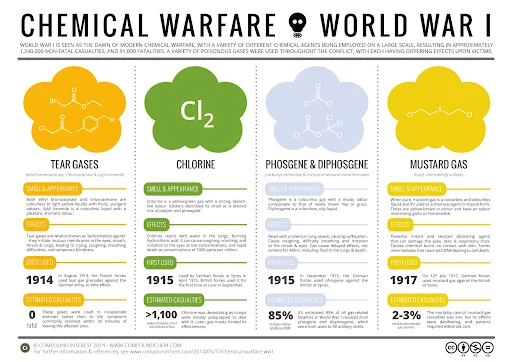
The tank sequence ends and small explosions erupt on the bare battlefield. These are not bombs, not smoke grenades, but a gas attack which the on screen text and narration describes and details in all its horrifying detail.
The camera shifts from the open field of
gas attacks (see graphic above) to a fox hole with soldiers wearing gasmasks. The scene is yellowish, as it would have been during a gas attack, with its yellowish fog moving into the fox hole.
Some masks were ill-fitting, or soldiers may have been too slow to don them during attacks. The frightening potential that could follow those issues is clearly seen, as one soldier tries to aid his dying fellow soldier, screaming in pain and horror as his respiratory system liquifies.
We return to the dance of bombs in the battlefield, wrapping up the sequence regarding gas and chemical warfare with a disturbing poem by British Soldier, Wilfred Owen.
We shift to a greater dance of bombs on a battlefield as we return to the main poem... which brings us back to where the music is, both in the poem and in Ravel's "No Man's Land", as soldiers from both sides, soldiers both alive and dead, are playing to the end.
We return to our soldiers in the fox hole, moments before the dying soldier falls, to see what led up to that scene of a gas attack, as both poem and music culminate in the finale of...Bolero.
And the soldier fatally falls from the attack at the exact moment of the music's end.
Thus ends the body of the film and the end of the orchestral music, beginning our... "Outro".
Adélaïde, states the obvious: 'It is over!"
And yet, it is only the music that is over. What now do these soldiers, healed and yet broken from their musical revelry among fellow combatants, friends and enemies. Once enemies and yet enemies, again? Or not? A tense, frustrating moment to suddenly be found in the most feared location in the war and on earth, between two enemy lines.
The dead, once again are dead. The living, looking all about, slowly return to reality, to their lines, to being again...enemies.
Where now has gone that feeling of humanity? Why does their feelings of war, of enemies, have to return?
The scene shifts to a blurry, fog based forest. Trees sparse and damaged. The film almost floats as the bucolic scene lifts and drops as if in a dream... and life for the soldiers returns to, normal? What is, "normal"?
Scenes of soldiers in trenches again, staring out through No Man's Land, at their enemy retreating, no doubt to their own trenches. Adélaïde describes these soldier's feelings. How for a time they feel almost normal, feeling their humanity, so foreign now to them. This humanness. While now, they must return, mentally, spiritually, physically... back into a war none of them wants.
Bored soldiers mill about in an open trench as Adélaïde continues the poem telling how Ravel's soldiers hung onto their unfamiliar feelings, now quickly escaping their grasp, as they begin to applaud. First one, then more, until finally they all enter into a full crescendo of applause.
In the poem, silence enshrouds Pvt. Ravel in his own realization that what just happened wasn't really about him at all. Rather it was about all those soldiers, on both sides, who had carried out what he was truly only a catalyst to.
While initially in the applause, Ravel felt pride in their appreciation for his music, for the experience, he quickly realizes it was not for him. Not at all. But was for them all, for those previous few moments of their return to being human beings once again.
The music returns to the initial Bolero piano music (played by Ravel) from the opening of the film as they all return to their places...physically, mentally, recognizing their places in this world. In this war, and through that temporary and pleasant "fog", so very different from their familiar and usual "fog of war", returning once again back into their "gutters", both of trench warfare and of their mental state of being.
Again we see foggy forests in the distance, and the floating feeling of the film, as we must consider the "forest for the trees" and where these men are for the moment, lost between reality and their mental state.
We return to having distance from the scene, from the poem, remembering this was all about Ravel and his Bolero. We return to the photo of a lone soldier amid a muddy field, as a photo of Ravel appears in his Camion uniform, staring directly at us, along with video of his memory of wishing to be a pilot, far about the battlefields.
We shift back to the foggy forests, to Ravel's mind. Back to his battle to see what he had just done in this fantasy in it being not for him at all, as it began for these soldiers, for his comrades, and for his enemies. All of them belonging not just to their tribes of Germans or opposing allies...but as human beings.
Ravel begins to realize how alone he is. How alone they all are, individually. And how together they all are in their separate ways. How perhaps he shouldn't have been enjoying it all quite so much. But to be fair, humans do need a reprieve from horror and the ever present watchful eye...of Death.
Pulling back again we see the soldiers in their trenches, still watching their enemies. Ever watchful as they have to be. Assuming on the other side, their "enemies" are doing the quite same.
Again we see those foggy forests in the distance as Adélaïde tells us Ravel returns alone to his line, to his own side's trench, until he back, secure in it as he realizes, as do they all, what is, and also what could be, and what one day will be.
This war will not after all last, as it seems now to be, forever.
Two very blurry soldiers walk toward us as Adélaïde tells us that all is returning to normal, as the fear, blood dripping all about, death and destruction still prevalent, returns us to the reality of the soldiers on whichever side they exist.
Death and terror...have returned.
We cannot shake the feeling from these soldier's movement toward us, that they seem somehow lighter, maybe...happier? They disappear into our lens as the screen fades to black, leaving us for a few moments alone. with only our thoughts.
Still blurry from the "fog of war", we see soldiers, officers exit a cave, walking toward us, heading to left of screen as if leaving the war (is it over?). Adélaïde brings the poem to its conclusion, and our film to its end.
As in the beginning when the titles appeared white, then turned red, they are now red, returning to white, returning us to our own reality and as our narrator informs us of Ravel's life after the war. And tells us a bit of what Ravel's contemporaries thought of him, and then what he did after the war. He finished his piece dedicated to five of his friends who did not survive the war, as that music plays under the narrator's story.
The music shifts to a more gentle piece as we hear how Ravel's career and his life ended. We see where he was laid to rest. It is also noted that because of Ravel's views on his works, in how all should be able to hear them, he believed in the concept of recordings, so others could hear great works. Because of that belief, we were able to play here, in this film, Ravel's original works. Including his own first public performance of Bolero, in one he not only attended, but also conducted. Though was up for contention by some, after the film was finished, it was uncovered that Ravel did indeed conduct this performance.
While I could have played a more perfect piece of music, I diligently strove to use all the original film, photos, prints, posters and music as possible, to be, even if not perfection, even if not as beautiful as it all could be, to be as original as possible. For us to be there, with Ravel, and with his fellow soldiers...on both sides. To see, hear, to expeirence the ugliness and at times, the beauty one can find in war.
And so thus ends our film of, "Pvt. Ravel's Bolero".
Credits
We go now into the credits next to footage of WWI settling on right of screen. The first thing mentioned in the credits is about the Outtakes reel, available for the difficult to read text, including extras not included, as well as the entire poem in one piece with narration by "Adélaïde", so it can be experienced without all the necessary distractions included in the film.
After the credits the two voice actors say their goodbyes in forms familiar to those in the days past of WWI.
Finally, a list of all wars on earth scrolls by. WWI is in all caps as it scrolls by. When WWII appears after a break with it's atomic ending, the explosion at Hiroshima from US archives underlies the scrolling text. It then continues with the wars AFTER WWII and up to the present illegal invasion by Russian Pres. Vladimir Putin against Ukraine, and is labeled so appropriately and reasonably as: "Putin's Folly".
The film then ends with one final quote:
For some, following the film will be the Outtakes reel. If it is not a part of the main film, it is available
separately.
FYI, the film companion book will obviously (and eventually...actually, already) be quite more comprehensive than this blog.
Either way thus ends (finally) this two-part blog on, "Pvt. Ravel's Bolero".